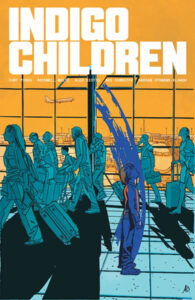
Unveiling the Cosmic Conspiracy: Image Comics' "Indigo Children Vol 1"
In the expansive universe of comic books, Image Comics consistently delivers groundbreaking narratives that push the boundaries of genre. Their latest offering, Indigo Children Vol 1, is no exception. This meticulously crafted sci-fi mystery plunges readers into a world where ancient secrets, extraterrestrial origins, and humanity's fate collide. Penned by the critically acclaimed duo of Curt Pires and Rockwell White, with breathtaking art by Alex Diotto, colors by Dee Cunniffe, and lettering by Hassan Otsmane-Elhaou, this graphic novel has already captured the imagination of critics and earned an early feature film option, signaling its immense potential. It’s a compelling journey that challenges perceptions and leaves readers questioning the very nature of truth and benevolence.
At its heart, Indigo Children Vol 1 explores what happens when the lines between savior and threat become dangerously blurred. Drawing comparisons to the cerebral intensity of titles like MIND MGMT, the series masterfully weaves a tale of disappearance, discovery, and ethical dilemmas set against a backdrop of cosmic intrigue. If you're looking for a series that combines pulse-pounding action with profound philosophical questions, then the world of the Indigo Children is ready to be explored.
The Disappearance and the Driven Reporter: A Mystery Unfolds
The premise of Indigo Children Vol 1 is immediately gripping: fifteen years ago, a group of preternaturally gifted children, collectively known as the Indigo Children, vanished without a trace. Their disappearance became an urban legend, a haunting whisper in the annals of unexplained phenomena. However, for tenacious reporter Donovan Price, it's an obsession he simply cannot let go. His relentless pursuit of the truth forms the backbone of the narrative, pulling readers deeper into a web of conspiracy and cosmic revelations.
Donovan's latest breakthrough comes in the form of a cryptic videotape. On it, one of the disappeared children, Alexei, makes a statement that shatters everything Donovan – and by extension, the reader – thought they knew. Alexei claims that the Indigo Children are not merely gifted Earthlings, but the sole survivors of a devastating holocaust on Mars. Fleeing their dying planet, they journeyed to Earth with a singular, profound mission: to prevent a similar annihilation from befalling humanity. This startling revelation immediately recontextualizes the title, twisting the familiar New Age concept of special, evolving human children into something far more ancient and alien.
Naturally, such a monumental secret is fiercely protected. Donovan finds himself stonewalled at every turn, as those with knowledge of the Indigo Children refuse to speak. An anonymous tip eventually leads him to the desolate landscapes of Russia, where one of the individuals from the tape is reportedly in hiding. But the closer Donovan gets to the truth, the more dangerous his quest becomes. An assassin's attempt on his life, cleverly disguised as a suicide, forces the journalist to confront the chilling reality that he is up against forces far more powerful and ruthless than he ever imagined. This escalating threat compels him to seek aid, leading him to recruit an unlikely ally – the "biggest gun" available – to navigate the perilous path ahead. Their journey promises to uncover a secret that could irrevocably alter the course of human history, as the Indigo Children are not only recovered and reunited but also threatened from within their own ranks, hinting at deeper divisions and moral complexities.
Beneath the Surface: Philosophical Depth and Ethical Dilemmas
What truly elevates Indigo Children Vol 1 beyond a mere sci-fi adventure is its profound engagement with complex philosophical questions. The narrative doesn't shy away from exploring humanity's potential reactions when confronted by extraterrestrial beings who claim to want to help. Would we embrace them as saviors, or would suspicion and fear prevail? The story expertly interrogates the very nature of benevolence, asking whether truly altruistic motives can exist when one party possesses overwhelmingly superior knowledge and power. This inherent tension is central to the narrative, reminding us that even the purest intentions can be perceived as a threat.
The concept of alien intervention raises significant ethical dilemmas. If the Indigo Children truly fled a dying world to prevent humanity's demise, what are the moral implications of their presence? Are they benevolent guardians, or are their methods and ultimate goals more ambiguous? The comic skillfully navigates the murky waters of good versus evil, demonstrating that, much like in real life, the boundaries are rarely clear-cut. While some antagonists are overtly malicious, the motivations and actions of others, including the Indigo Children themselves, are painted with shades of gray, prompting readers to critically evaluate who is truly "good" and who might be a more subtle, yet equally dangerous, force.
The overarching theme of preserving "what's ours" in a collapsing world resonates deeply. It's a reflection of contemporary anxieties about global crises and the instinct to protect one's own, even at the cost of understanding or embracing external aid. This graphic novel serves as a compelling thought experiment, delving into the ethics of survival, interspecies interaction, and the potential for both unity and conflict when facing existential threats. For a deeper dive into these complex questions, consider reading our related article: The Indigo Children: Alien Saviors or Threat to Humanity?
The Artistic Vision and Creative Team Behind the Saga
The captivating narrative of Indigo Children Vol 1 is brought to life by an exceptional creative team. Curt Pires and Rockwell White craft a story that is both intricate and emotionally resonant, building on Pires' reputation from the acclaimed series Youth. The visual storytelling by Alex Diotto, with his distinctive style, and the vibrant, mood-setting colors by Dee Cunniffe are integral to the series' success. Hassan Otsmane-Elhaou’s lettering ensures that the dialogue and narrative flow are seamless, drawing the reader deeper into Donovan's harrowing investigation.
The review noted strong MIND MGMT vibes not just in story but also in art, suggesting a stylistic choice that often leans into experimental or less conventional paneling and character rendering to enhance the psychological tension and conspiracy aesthetic. While the color work is consistently praised for its strength and atmospheric contribution, some readers have pointed out that the line art, particularly as new characters are introduced, can become rudimentary. This occasionally makes it challenging to distinguish between characters, especially a cast of "pale guys" involved in the shadowy government conspiracy. While it’s fair to desire clearer visual cues for important characters – perhaps even simple labels or distinct uniforms – this stylistic choice might also serve to underscore the anonymity and ubiquity of the clandestine forces at play, turning a potential critique into a thematic element. It hints at how identities are deliberately obscured, blurring the lines of who is truly pulling the strings, a plot twist that will hopefully be unveiled in future volumes.
From Page to Screen: The Future of Indigo Children
The buzz around Indigo Children extends far beyond the comic book pages. The series has already been optioned for a feature film, with Jeff Ludwig, known for his work as a producer on titles like Alan Wake, at the helm. This early film option speaks volumes about the cinematic potential of the story. Its high-concept sci-fi premise, conspiracy-laden mystery, and action sequences, coupled with profound philosophical questions, make it ripe for adaptation to the big screen. The narrative's compelling character arcs and the overarching mystery of the Indigo Children's origins and purpose offer rich material for a visually stunning and intellectually stimulating cinematic experience.
The fact that Indigo Children is an ongoing series, with Vol 1 ending on a riveting cliffhanger, only amplifies the excitement for its future. The creative team has meticulously crafted a world that promises many more layers of mystery and conflict, particularly as the internal threats to the reunited Indigo Children come to light. The anticipation for subsequent volumes, and the prospect of seeing this intricate story unfold in both comic book and film formats, is palpable. To understand more about this exciting transition, read our article: From Comic Book to Film: The Rise of Indigo Children.
Indigo Children Vol 1 also boasts an impressive lineup of variant covers by esteemed artists such as Tyler Boss, Tula Lotay, and Jenny Frisson. These stunning alternative covers not only provide collectors with unique artwork but also highlight the artistic reverence and widespread appeal that the series has already garnered, even in its early stages.
Conclusion
Indigo Children Vol 1 is a triumphant debut from Image Comics, offering a sophisticated blend of sci-fi, mystery, and deep philosophical inquiry. Curt Pires, Rockwell White, Alex Diotto, Dee Cunniffe, and Hassan Otsmane-Elhaou have delivered a graphic novel that is both visually captivating and intellectually stimulating. With its intricate plot, compelling characters, and themes that resonate with contemporary anxieties, this series is a must-read for anyone seeking a thought-provoking escape into a world where the fate of humanity hangs in the balance. As Donovan Price continues his relentless search for truth, readers will undoubtedly find themselves eagerly anticipating the next chapter in the unfolding saga of the Indigo Children. Don't miss out on what promises to be one of the most intriguing new series in comics today.