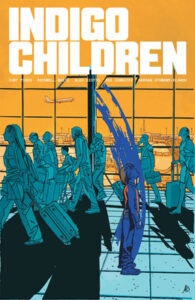
The very idea of beings from another world arriving on Earth often sparks a primal mix of hope and fear within us. Are they here to enlighten us, to guide us towards a better future, or do they harbor intentions that could unravel the fabric of human civilization? This profound question lies at the heart of the enigma surrounding the so-called Indigo Children, a group of preternaturally gifted individuals whose origins and purpose are shrouded in mystery, and who have recently been brought into sharp focus by a gripping new comic book series.
For decades, the term "Indigo Children" has resonated in certain circles, often associated with a generation believed to possess unique spiritual and psychological attributes, poised to usher in a new era of consciousness. However, the latest iteration of this concept, as presented in Curt Pires and Rockwell White's acclaimed graphic novel series, shifts the paradigm dramatically. Here, the Indigo Children are not merely spiritually advanced humans; they are something far more alien, far more potent, and potentially far more world-altering.
Unveiling the Enigma: Who Are the Indigo Children?
Fifteen years ago, a cohort of extraordinary children, collectively known as the Indigo Children, vanished without a trace. Their disappearance became a haunting urban legend, a whispered tale among those who remembered their uncanny abilities and enigmatic presence. For intrepid reporter Donovan Price, however, the story was never just a legend; it was an obsession. He has relentlessly pursued every lead, every whisper, convinced that the truth of their disappearance held a secret that could redefine humanity's understanding of itself.
Price's tireless investigation eventually unearths a crucial piece of evidence: a cryptic video tape. On it, one of the disappeared children, Alexei, delivers a chilling revelation. Their group, the Indigo Children, are not from Earth at all. They are the last survivors of a devastating holocaust on Mars, their home planet. This astonishing claim immediately elevates their story from a terrestrial mystery to an interstellar drama, fundamentally altering the stakes involved.
A Martian Exodus: The Genesis of the Indigo Children
Alexei's testimony paints a vivid, albeit terrifying, picture of their past. Fleeing a dying world, the Martian survivors made their way to Earth with a singular, profound mission: to prevent our planet from succumbing to the same annihilation that befell theirs. This narrative posits the Indigo Children as cosmic guardians, burdened with the immense responsibility of averting catastrophe for an adopted species. Yet, their perspective carries an implicit, unsettling undertone – that humanity, in its current state, is somehow "inferior" or prone to self-destruction, requiring external intervention.
This Martian genesis transforms the narrative from a simple quest for answers into a complex ethical debate. If these advanced beings genuinely wish to help humanity, what form will that assistance take? Will it be guidance, subtle nudges towards a better future, or a more direct, perhaps even imposing, form of intervention? The line between benevolent oversight and paternalistic control becomes increasingly blurred. Sci-fi enthusiasts will recognize this dilemma as a classic trope: the advanced civilization confronting a less developed one, grappling with the Prime Directive and the ethics of non-interference versus necessary aid. The arrival of the Indigo Children Vol 1: Image Comics' New Sci-Fi Mystery, brilliantly penned by Curt Pires and Rockwell White with art by Alex Diotto, Dee Cunniffe, and Hassan Otsmane-Elhaou, dives deep into these compelling questions, leaving readers to ponder the true cost of salvation.
Benevolent Overseers or Imposing Conquerors? The Ethical Quandary
The core tension of the Indigo Children saga lies precisely in the question posed by its title: are these alien beings genuine saviors, or do they represent a profound threat to humanity's autonomy and future? The graphic novel meticulously interrogates what humanity’s reaction would truly be if confronted by aliens who claim to want to help. Donovan Price's investigation quickly reveals that not everyone is eager for the truth to emerge. An anonymous source leads him to Russia, where one of the children from the tape is in hiding, but a ruthless assassin attempts to silence Donovan, staging his death as a suicide. This immediately signals a powerful, unseen force at play, intent on keeping the Indigo Children contained and their secrets buried.
The presence of shadowy "government people" conspiring to control or eliminate the Indigo Children underscores humanity's inherent fear of the unknown and its struggle to cede control. Is their opposition driven by genuine concern for humanity's sovereignty, or by a more sinister desire for power and control over an alien technology or lineage? The graphic novel masterfully portrays that, much like in real life, the question of who is "good" and who is "bad" is far from clear-cut. Even among the Indigo Children themselves, internal conflicts and differing coping mechanisms threaten to fracture their unity, suggesting that even alien benevolence might come with its own set of moral ambiguities.
This nuanced portrayal challenges readers to consider the complexities of interspecies relations. If a species deemed "inferior" were offered salvation by a "superior" one, what would be the ethical implications? Would humanity embrace such help, or would its pride and fear lead to conflict? It's a fascinating thought experiment, urging us to consider our own capacity for trust, adaptation, and critical evaluation when faced with monumental, world-changing revelations.
Beyond the Pages: The 'Indigo Children' Phenomenon and its Future
The compelling narrative of the Indigo Children has resonated deeply, establishing the series as a significant entry in contemporary science fiction. From the critically acclaimed creative team behind the smash-hit series Youth, the ongoing saga launched in March from Image Comics and has garnered considerable attention for its intricate plot, evocative art, and thought-provoking themes. The initial reception has been overwhelmingly positive, praising its strong "MIND MGMT vibes" and its deep dive into the ethics of a collapsing world and the primal instinct to preserve "what’s ours."
The impact of the Indigo Children story is set to extend far beyond the comic book pages. The series has already been optioned for a feature film, with development currently underway under the guidance of Alan Wake producer, Jeff Ludwig. This monumental step signifies the broader appeal and cinematic potential of the narrative, promising to bring the complex tale of alien saviors and human intrigue to an even wider audience. The transition From Comic Book to Film: The Rise of Indigo Children highlights the power of storytelling to tackle universal questions about identity, survival, and our place in the cosmos.
As the series continues, readers and future film audiences will undoubtedly grapple with its central questions: Can humanity accept help from beings it perceives as both superior and alien? And how will the Indigo Children ultimately choose to fulfill their self-appointed mission – as compassionate guides, or as reluctant overlords? The journey of Donovan Price and the recovered Indigo Children promises to unravel a secret that could truly change the world forever, forcing us to confront not just the mysteries of the universe, but the deepest truths about ourselves.
The saga of the Indigo Children presents a captivating thought experiment wrapped in a thrilling sci-fi mystery. It compels us to consider not only the possibility of alien life and intervention but also our own definitions of heroism, threat, and what it truly means to be human. Whether they prove to be the ultimate saviors offering a path to survival, or a profound threat to our self-determination, their story is a gripping exploration of humanity's preparedness for contact and the profound moral questions that such an encounter inevitably raises.